Data Scope
Data analysis may have diffrent scope. It is very desirable to collect data about all the enties (population) of our interest. It is, however, in most situations, either impossible or impractical to collect data about all the entities. Thus we are forces to deal only with some (sample) of entities.
Population is the collection of all entities being studied. It can be finite or infinite.
As mentined, it is either impossible or economically infeasible to study the entire population. The census is an attempt to collect data about every individual living in a country.
Therefore it gets close to the population of the country's residents as much as possible. Because of its high cost, census is perfrmormed every 10 years.
A formal representation of the population depends on its data type (see Data Types). Generally, a population's data is a set, Pop, of numbers or categories:
Pop ⊆ ℝ - a subset of real numbers.
Pop ⊆ ℤ - a subset of integers (whole numbers).
Pop = {c1, c2, ..., cN} - a collection (set) of N categories (labels, tokens, etc.
Pop ⊆ ℤ - a subset of integers (whole numbers).
Pop = {c1, c2, ..., cN} - a collection (set) of N categories (labels, tokens, etc.
It is common to use a capital letter, N, to denote the population size.
Population Examples
Travel Time population, {Time it takes to drive from Boston to New Your City}, a numeric (quantitaqtive) population.
It is theoretically an infinite population whose members belong the set of the positive real numbers, (0, + ∞).
It is theoretically an infinite population whose members belong the set of the positive real numbers, (0, + ∞).
Color Preference, {Color preferred by all students at the University of Statistics }, a categorical (qualitative) population.
One would have to interview all the students on campus to get this population.
It is a large collection of N color names, {blue, blue, green, red, green, yellow, brown, blue, ...}.
One would have to interview all the students on campus to get this population.
It is a large collection of N color names, {blue, blue, green, red, green, yellow, brown, blue, ...}.
Sample is a subset of the population (S ⊆ Pop). A sample captures actual data being analyzed in order to learn more about the population. A sample is a collection of categories,
{cr(1), cr(2), ..., cr(n)}, where cr(1) ∈ Pop,
{cr(1), cr(2), ..., cr(n)}, where cr(1) ∈ Pop,
or numbers,
{xr(1), xr(2), ..., xr(n)}, where xr(1) ∈ Pop.
It is common to use a lower-case letter, n, to denote the sample size.
There are many different ways to select a sample from its population. In most cases, presented in this instruction, analyzed samples are the so called simple, random samples. It means that the sample elements are selected from the population independtly and based on the equal-chance principle.
Sample Examples
A Travel Time sample (recorded by 9 randomly selected drivers) [h]:
{3.62, 3.55, 3.65, 3.16, 3.49, 3.54, 3.2, 4.03, 3.73}.
It is a numeric (quantitative) sample.
{3.62, 3.55, 3.65, 3.16, 3.49, 3.54, 3.2, 4.03, 3.73}.
It is a numeric (quantitative) sample.
A Color Preference sample (collected from 8 randomly selected students):
{blue, blue, green, red, green, yellow, brown, blue}
This is a categorical (qualitative) sample.
{blue, blue, green, red, green, yellow, brown, blue}
This is a categorical (qualitative) sample.
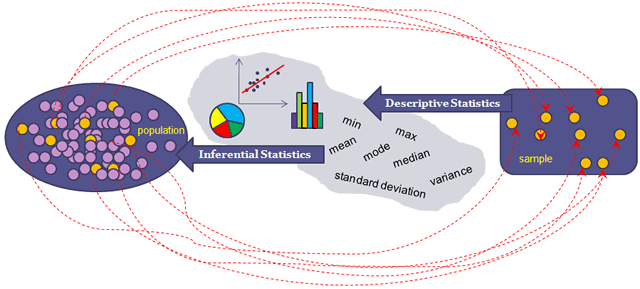
To study a population, first a sample is selected from the population. Next the sample is described by means of summary measures and/or frequency distribution.
Finally, using the descriptors, inferential procedures are employed to reason about the population.
References
| Wikipedia-Population (2020). Statistical population. URL - Source | |
| Wikipedia-Sample (2020). Sample (statistics). URL - Source |